Stop Building Chatbots. Start Building Message-Driven Systems.
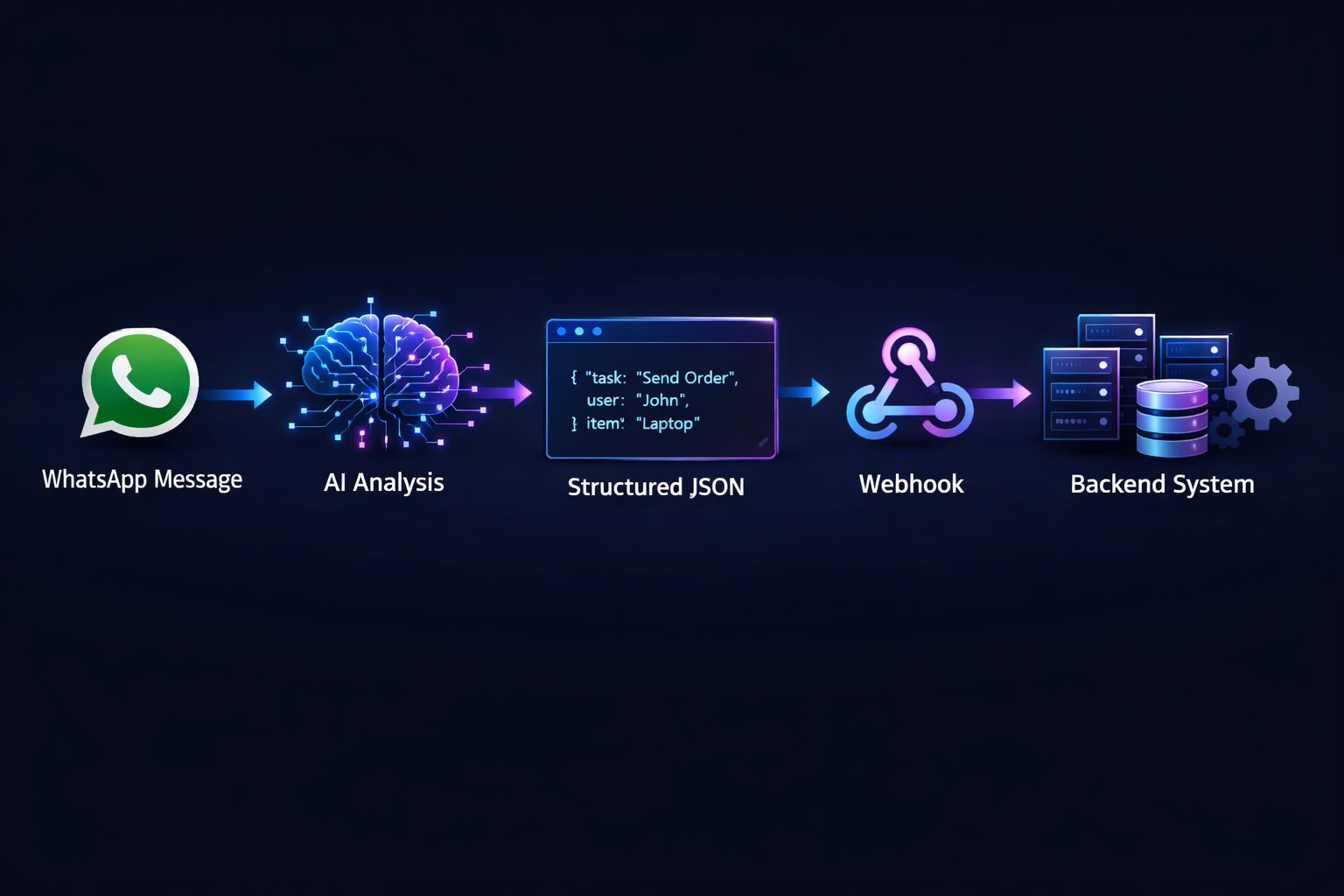
Most teams building on WhatsApp are building chatbots. Multi-turn conversations, intent trees, fallback loops — the whole nine yards.
But here's the thing: most of them don't actually need a chatbot.
They need a system that turns incoming messages into backend actions.
The Chatbot Trap
A hotel guest sends:
"Can I get extra towels in room 312?"
The typical chatbot approach:
Bot: Hi! How can I help you?
Guest: I need towels
Bot: Which room?
Guest: 312
Bot: How many towels?
Guest: ...just some towels
Bot: I didn't understand. How many towels would you like?
3 round-trips to extract 2 fields. The guest is annoyed. The developer is maintaining a conversation state machine. Everyone loses.
Messages Are Not Conversations
Here's the insight: most inbound messages already contain everything you need. You don't need to ask follow-up questions — you need to extract what's already there.
The shift is simple:
Message
  ↓
Analysis (single LLM call)
  ↓
Structured payload
  ↓
Backend action
One message in, one structured payload out. No conversation state. No dialog trees. No "I didn't understand."
What This Looks Like in Practice
The same message — "Can I get extra towels in room 312?" — processed as a message-driven system:
{
  "intent": "room_service_request",
  "confidence": 0.97,
  "actions": [
    {
      "type": "housekeeping.task.create",
      "payload": {
        "room": "312",
        "item": "extra towels"
      }
    }
  ],
  "suggested_reply": "Of course! Extra towels are on the way to room 312."
}
Your backend receives this via webhook. You create the task in your PMS. You send the reply. Done.
One message. One payload. One action.
The Architecture
Here's the full flow — from WhatsApp message to backend action:
WhatsApp (inbound message)
  ↓
Pre-filter (spam, noise — no LLM cost)
  ↓
Router (classify + route to the right agent)
  ↓
Agent (LLM call → structured output)
  ↓
Webhook (HMAC-signed payload to your app)
  ↓
Your backend (create task, update booking, send reply)
Each step is deterministic. The LLM is used once, for extraction — not for conversation. The output is a structured JSON payload your backend can trust.
Code, Not Config
Here's what triggering an agent looks like with the Ruby SDK:
require "whatsrb"

client = WhatsRB::Client.new(api_key: "wrb_live_xxx")

run = client.agents.run(
  agent_id: "agt_abc123",
  input: "Cancel booking #BK-4521"
)

puts run.output
# => { "intent" => "cancel_booking", "actions" => [...] }
Or with a simple curl:
curl -X POST "https://api.whatsrb.com/v1/agents/agt_abc123/runs" \
  -H "Authorization: Bearer wrb_live_xxx" \
  -H "Content-Type: application/json" \
  -d '{"input":"Cancel booking #BK-4521"}'
You get back a structured payload. Every time. No conversation state to manage.
When Chatbots Make Sense (And When They Don't)
| Use case | Chatbot? | Message-driven? |
|---|---|---|
| Customer FAQ with branching logic | Yes | No |
| "Book a table for 4 at 8pm" | No | Yes |
| "Cancel my order #12345" | No | Yes |
| "AC broken in room 204" | No | Yes |
| Guided product recommendation | Yes | No |
| "Where's my shipment TRK-789?" | No | Yes |
If the message already contains the intent and the data — you don't need a chatbot. You need a message-to-action pipeline.
Real Results
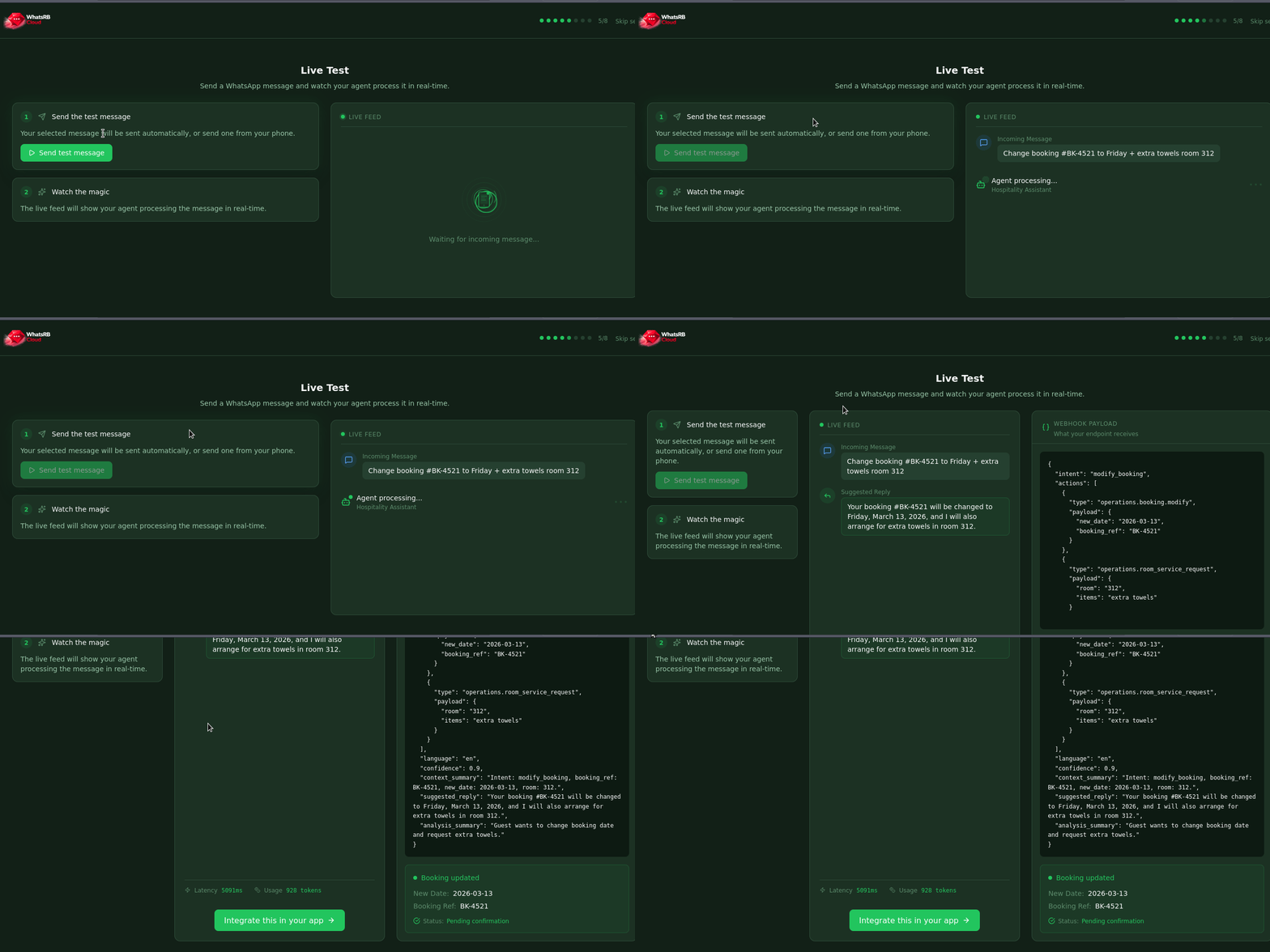
With this approach:
- No conversation state to maintain
- Single LLM call per message (~1-2s latency)
- Deterministic outputs your backend can trust
- 90%+ accuracy on intent + field extraction out of the box
This Is What We're Building
WhatsRB Cloud is a platform that turns WhatsApp messages into structured, actionable webhooks. No chatbot framework. No dialog trees. Just messages in, actions out.
Check out the API docs to see how it works under the hood.
Built with Ruby, Rails, and a healthy distrust of chatbots.